
Hip-hop has always communicated through more than sound.
Clothes, neighborhoods, album artwork, cars, dance, photography, typography, live performance, and music videos all contribute to how an artist is understood. Long before a listener studies every lyric, a visual can establish attitude, ambition, geography, personality, or mood.
That makes music-video production especially important for independent hip-hop artists.
The objective is not simply to make footage look expensive. Plenty of memorable visuals have been created with contained locations, lean crews, practical environments, and straightforward camera setups. What matters is whether the production choices feel connected to the record and the person performing it.
Expensive equipment cannot manufacture identity.
Clear creative decisions can protect it.
Here are ten production choices that help hip-hop artists turn a track into a visual world rather than another forgettable performance clip.
1. Build the Concept From the Artist, Not the Trend
Visual references are useful until they begin replacing identity.
Open almost any social feed and the same techniques appear repeatedly: dark warehouses, luxury vehicles, fisheye lenses, neon rooms, handheld street footage, rapid zooms, vintage textures, heavy film grain, elaborate transitions, or highly polished performance spaces.
None of those choices is inherently weak.
The problem begins when they have no relationship with the artist.
Start with the record.
What does the track reveal that listeners should also feel visually?
Aggressive production might call for tension and movement, but that does not automatically mean fast editing. Introspective lyrics may work inside an enormous landscape rather than a dark room. Regional identity may deserve to become part of the visual language instead of being hidden behind a generic studio set.
HipHopSince1987 recently highlighted Delhi-based studio MONTAGE and its approach to the visual language of India’s emerging hip-hop underground. The work described there leans into atmosphere, texture, practical locations, and realism rather than assuming spectacle is the only path to impact.
That distinction matters.
The strongest concept often feels like something only that artist could have made.
2. Let the Location Say Something
Hip-hop visuals have a long relationship with place.
Neighborhoods, corner stores, houses, rooftops, studios, basketball courts, parking lots, clubs, industrial areas, stages, and city streets can communicate context without a line of explanation. The cyberpunk neon sign can help with it.
Using a real environment, however, involves more than finding an attractive background.
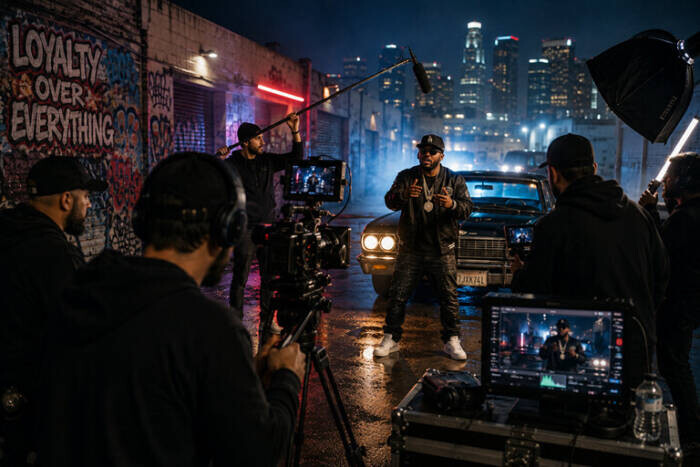
Production still needs to understand where vehicles can stop, how equipment gets to set, whether public activity can be controlled, how much power is available, where the artist can change wardrobe, what ambient sound exists, and when access ends.
Music playback introduces another practical issue.
Residential locations or operating businesses may restrict volume. Public spaces can become unpredictable once crowds gather. Night locations may have strict closing times.
HipHopSince1987’s coverage of Poetic G’s “Thee Original” noted how the neighborhood itself supported the video’s connection to the music. That is the value of location when it works properly: the environment becomes part of the record’s personality rather than decoration.
Choose spaces for meaning, then scout them for reality.
3. Budget Around What the Audience Will Actually Feel
Limited budgets force useful questions.
Does the video really need four locations?
Will another vehicle create more impact than better lighting?
Does the second performance setup add something the first cannot?
Would one carefully designed room look stronger than three rushed locations?
Every additional idea creates operational consequences.
Location moves involve packing, loading, travel, parking, unloading, rebuilding camera systems, relighting, resetting talent, and getting everyone ready again.
That time comes out of the same day intended for performance.
Independent artists often gain more by concentrating resources.
One memorable environment, enough time to light it properly, strong wardrobe, thoughtful art direction, and controlled performance coverage can outperform a larger concept spread too thinly.
Spend where the viewer will notice the result.
4. Give Performance Enough Space to Become Believable
Music videos may use playback, but the performance still has to feel alive.
Artists need enough familiarity with camera position, movement, eyelines, physical marks, props, and choreography to perform rather than troubleshoot.
Close-up performance requires different energy from a full-body wide shot.
Direct eye contact can feel confrontational in one section of a song and overly aggressive in another. Moving through a location changes focus, lighting, and playback requirements. Group performance introduces continuity between takes.
Rehearse the technical structure before demanding emotional energy.
That does not mean scripting every movement.
It means removing enough uncertainty that the artist can stop thinking about production mechanics.
Performance becomes more convincing once the set stops feeling like a technical test.
5. Build the Crew Around the Idea
Crew requirements follow technique.
Lean street visuals can often work with small, mobile teams.
Complex choreography, moving vehicles, large lighting setups, controlled locations, multiple cast members, extensive art direction, specialized camera movement, or complicated post-production require more defined responsibilities.
Clarify who handles:
- Camera
- Focus
- Lighting
- Grip
- Playback
- Sound where needed
- Media and backups
- Production coordination
- Locations
- Wardrobe
- Hair and makeup
- Art direction
- Behind-the-scenes content
Equipment ownership also needs clarity.
Does the cinematographer’s quote include a camera package? Does the lighting team bring fixtures? Who provides wireless monitoring? How much media is included?
Projects using music video production planning can coordinate concept, filming requirements, crew, locations, and post-production around the visual direction instead of assembling each element without shared context.
Clear responsibility protects creative time.
6. Capture Coverage With Rhythm in Mind
Music gives editors a structure that other forms of video do not have.
Verses, hooks, ad-libs, beat changes, instrumental breaks, intros, and outros create natural opportunities for visual variation.
That does not mean cutting on every beat.
Constant rhythmic cutting can become predictable.
Editors need visual choices that let them decide when to follow the music and when to work against it.
Performance coverage might include:
- Full-song master takes
- Tight facial performance
- Profile angles
- Wide environmental frames
- Moving camera passes
- Hand details
- Wardrobe details
- Group reactions
- Location textures
- Narrative inserts
- Slow-motion moments where technically appropriate
Ask what each setup contributes before shooting it.
Extra footage only has value when it gives the edit another useful option.
7. Use Camera Movement With Intention
Hip-hop videos have room for aggressive visual technique.
Handheld movement, dollies, gimbals, zooms, low angles, high angles, rotating cameras, vehicle rigs, drones, and unconventional lenses can all create energy.
The tool still needs a reason.
Movement may make the performer feel larger than the environment. Static framing can create tension. Slow movement might pull the viewer deeper into an introspective verse. Wide lenses placed close to the performer can produce a completely different psychological effect from long lenses across the street.
Technique communicates.
Using every available technique at once usually communicates less.
Pick a visual grammar and allow selected moments to break it.
That contrast often gives the biggest shots more impact.
8. Plan the Video as Part of the Release, Not the End of It
The finished music video may be the hero asset, but it is rarely the only visual content an artist needs.
Release campaigns can also use:
- Vertical teasers
- Performance clips
- Behind-the-scenes footage
- Short interviews
- Cover artwork material
- Thumbnail frames
- Rehearsal footage
- Social edits
- Clean performance excerpts
- Tour or show visuals
HipHopSince1987’s recent Free Music Marketing Guide for Independent Artists makes a similar practical point: existing interviews, performances, music videos, rehearsals, studio footage, and songwriting material can support multiple pieces of promotional content rather than every post starting from zero.
Production should anticipate that ecosystem.
Tell the cinematographer which sequences need vertical versions.
Protect composition for alternate crops.
Capture a few clean shots without lyrics or campaign-specific graphics.
Record behind-the-scenes material deliberately rather than leaving it to whoever happens to have a phone nearby.
One shoot can create weeks of useful visual material when those outputs are planned.
9. Protect the Visuals With Real Production Discipline
Creative energy does not make footage invulnerable.
Cards fail.
Files get mislabeled.
Drives disappear.
The wrong take gets flagged.
Talent agreements fail to cover the intended distribution.
Locations contain artwork or branding nobody noticed during scouting.
Production discipline protects the work from these problems.
Before cards are formatted, footage needs verified backups.
Separate copies are safer than two drives traveling in the same bag.
Folder structures should identify camera, shoot day, location, and other useful information.
Post-production notes can identify preferred takes, technical problems, incomplete shots, or visual effects requirements.
Rights deserve the same attention.
Featured performers, recognizable background talent, private locations, artwork, photographs, archive material, and other protected elements may require permissions depending on the production and intended use.
The coolest shot in the edit has limited value if the team cannot confidently release it.
10. Think Globally Without Making the Artist Look Generic
Hip-hop crosses borders without losing the importance of place.
HipHopSince1987 has covered how Mohamed Ramadan combines Middle Eastern identity with visual language influenced by global hip-hop aesthetics, demonstrating how artists can participate in an international culture without erasing their own context. (hiphopsince1987.com)
That lesson applies directly to production.
Artists traveling for videos do not need to imitate the city where they are filming.
Locations, local crews, fashion, architecture, performers, production design, and regional creative communities can add new texture while the artist’s identity remains central.
International shoots introduce practical complications, though.
Equipment availability changes between markets. Permit systems differ. Local crew structures vary. Transportation estimates can be unreliable from a distance. Weather, language, access, and working practices all affect the schedule.
Projects requiring international production support can connect local crews, equipment, locations, permissions, logistics, filming, and post-production within a coordinated structure.
The objective is not to make every location feel interchangeable.
It is to give the creative team enough local knowledge to use each place intentionally.
Visual Identity Is Built Through Repetition
One strong video can attract attention.
Several visually connected releases can build recognition.
That does not mean every music video needs the same colors, location, director, or camera technique.
Consistency can exist at a deeper level.
Perhaps the artist repeatedly favors real environments over sets.
Maybe the visual language stays observational and intimate.
Another artist may build a world around fashion, controlled art direction, surreal imagery, or highly choreographed performance.
Audiences begin recognizing those decisions as part of the artist.
HipHopSince1987’s coverage of artists such as Nukiknowws has emphasized how cinematography, dark aesthetics, and immersive storytelling can strengthen the world around a release.
That is where music-video production moves beyond promotion.
It becomes brand memory without feeling like corporate branding.
The Video Should Make the Record Feel Bigger, Not Busier
Hip-hop visuals do not need to prove how much money was spent.
They need conviction.
The strongest videos know which details matter and which ones can disappear.
Concept protects identity.
Locations provide context.
Lighting creates mood.
Performance creates connection.
Crew structure protects execution.
Coverage gives the editor options.
Rights and backups protect the finished work.
Release planning gives the footage a longer life.
None of that requires a production to become oversized.
HipHopSince1987 has even published guidance for local musicians on producing their own music videos, emphasizing that artists can begin with simpler concepts and focus on storytelling rather than assuming high budgets are the only route to meaningful visuals. (hiphopsince1987.com)
That principle remains valuable at every budget level.
More resources create possibilities.
Clearer choices create identity.
The goal is not to make the audience think about the camera, the rental package, the production company, or how many people were standing behind the monitor.
The goal is to make the visuals feel inseparable from the record.
When that happens, the music video stops looking like content made to promote a song.
It starts feeling like part of the culture around it.
© 2026, StanleyGatero. All rights reserved.