

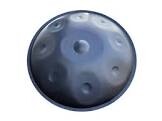
Is It Hard to Learn to Play the Handpan?
Yes, most beginners can start making simple, musical sounds on a handpan without prior training, though playing with control takes regular practice. A few gentle taps can make a melody right away, which makes it easier to get started than many instruments. A tone field is one of the tuned areas around the Ding that produces a distinct note when struck.
You do not need musical experience to learn to play handpan. The notes are tuned to a particular scale, so playing within that scale makes dissonant notes less likely. That can make early exploration feel welcoming, even if you cannot read music or keep a steady beat yet.
Making a first sound is easy; shaping a clear phrase takes time. You will gradually build a sense of rhythm, learn to control each note, and find musical ideas that feel like your own. Early practice can stay simple: listen closely, repeat a few notes, and notice how your touch changes the sound.
You can begin with the notes already on your instrument, then build skill one small practice session at a time.
Is It Easy to Learn to Play Handpan?
The first notes are usually approachable because the handpan’s notes belong to a set scale, but clean touch and steady rhythm take practice. At first, you can explore the available notes without needing musical experience or music theory.
The fixed set of notes makes exploration easier, not automatic. A scale makes dissonant or incorrect notes less likely when you stay within its notes, but some combinations can still sound tense or unfamiliar.
Treat the scale as a useful safety net, not a substitute for learning control.
Your fingers still need to touch each tone field with enough speed and precision to let it ring. A heavy strike can sound harsh, while contact that lingers can mute the note. Building a clean touch takes patient repetition.
Rhythm asks for a different kind of attention. You may find notes that sound pleasant, yet still need practice to keep a pulse, repeat a pattern evenly, and place each note where you intend.
Playing confidently means coordinating touch, timing, and musical choices, not just finding notes that sound good. Start with a few notes and a slow, repeatable pulse. Add complexity only when your hands can keep the simple pattern steady.
Once the basics feel familiar, you can use short melodies to hear where your timing shifts. Treat the scale as a useful safety net, not a substitute for learning control.
How Long Does It Take to Learn the Handpan?
With focused daily practice, a beginner may establish clean tone, learn the scale layout, and play a simple beat within 1-30 days. Steady practice helps you build those skills faster than occasional sessions, though progress depends on your starting point and practice habits.
These are practice milestones, not a promise of mastery on a fixed date. You may reach one skill sooner and need more time for another. Use the stages as a guide for choosing what to work on, not a deadline.
|
Stage |
Approximate timeframe |
Skills to focus on |
|
First month |
1-30 days |
Clean tone, scale layout, simple beat, striking technique, posture, alternating-hand patterns |
|
Developing skills |
1-6 months |
Rhythmic independence, chords, ghost notes, syncopation; complex chords may come by month four with 30 minutes of daily practice |
|
Advanced development |
6-12 months |
Complex polyrhythms, rapid arpeggios, original compositions, double strokes |
During the first 30 days, focus on producing a clear note and learning where each note sits. Basic alternating-hand patterns can help you move between notes without relying on one hand.
From one to six months, your practice can include rhythmic independence, chords, ghost notes, and syncopation. A player practicing 30 minutes daily may be able to incorporate complex chords by month four.
Between six and 12 months, you might work on complex polyrhythms, rapid arpeggios, original compositions, and double strokes. These skills need time because each asks for more coordination than a simple beat.
Use the next skill you can play cleanly as your measure of progress, rather than expecting to master the instrument by a particular month.
How Should You Sit and Position a Handpan?
A stable seated position with the handpan resting comfortably on your thighs is a practical place to begin. Comfort matters: your hands should move freely without forcing your shoulders or back into an awkward angle.
The lowest notes should be easy to reach without shifting your torso. Players commonly place those notes nearest the chest. You can also use a stand, as long as it holds the instrument securely at a comfortable height.
Seated placement: Rest the instrument on your thighs, with enough room for your hands to move around it.
Stand height and stability: Set the stand so you can reach the notes, then check that the instrument does not wobble.
Relaxed posture: Let your shoulders drop and keep your back comfortable instead of leaning over the surface.
Instrument orientation: Turn the handpan until the lowest notes sit nearest your chest and are easy to reach.
A low chair can help place your knees slightly above your hips, giving the instrument a steady base. Adjust the chair or stand if the handpan feels too high or low.
Your arms should reach the playing surface without stretching. If you have to lean forward, twist, or lift one shoulder to reach a note, change the setup before practicing.
Before playing, check that every note is reachable without leaning or twisting.
How Do You Read a Handpan’s Layout?
Start by locating the central Ding, then identify the surrounding tone fields and any bottom opening. A chart can show how those parts relate and name the notes on your instrument.
Check the layout and orientation before using a chart to identify notes. Handpans can have different note arrangements, and a chart drawn from above may not match your view until you turn it correctly.
Find the Ding, Tone Fields, and Gu
The Ding is the central note, with other notes arranged around it in a scale. Each surrounding tone field produces a distinct note when struck. Together, these tuned areas create the instrument’s main playing surface.
Some handpans also have a bottom sound hole called a Gu. A layout with bottom notes can offer extra bass or harmonic options, but using those notes may require more coordination. A top-notes-only layout can feel more intuitive when you are learning.
Read a Chart’s Scale and Orientation
A handpan chart commonly shows the scale name and root, the Ding, surrounding tone fields, and the instrument’s orientation. The root is the note that gives the scale its name. Use the chart’s position markers to match the drawing to the instrument in front of you.
Octave numbers distinguish notes with the same letter name at different pitches. For example, D3 and D4 are both D notes, but they sit in different octaves. Those labels help you understand which pitch a written note identifies.
|
Layout feature |
Top-notes-only layout |
Layout with bottom notes |
|
Where the notes are |
On the top surface |
On top and bottom surfaces |
|
Beginner feel |
Often more intuitive |
May require more coordination |
|
Added options or coordination |
Fewer bass and harmonic options |
More bass and harmonic options; extra coordination |
Check the chart’s orientation before matching a written note to the instrument.
What Is the Right Way to Strike a Handpan?
A clear note comes from a quick, light fingertip strike followed by an immediate release. Let the sound ring by allowing your finger to rebound instead of staying on the surface.
Use a relaxed touch rather than force. Strike the Ding directly. For notes around it, players commonly strike the ridge between a tone field and its dimple.
Relax your fingertip and wrist so the movement stays loose.
Make quick contact with the playing surface, then release right away.
Avoid excessive force or prolonged contact with a tone field.
Many players use their thumbs for nearby notes and their index and middle fingers for many others. Choose a movement that feels natural while keeping your hands relaxed.
A quick, elastic strike gives a note room to resonate. If your finger remains on a tone field, it can damp the vibration and shorten the sound.
Do not assume that striking harder will fix a weak or muted note. First notice whether your fingertip is contacting the intended area and lifting cleanly.
Mallets are not suitable for every handpan, and their use depends on the maker’s instructions. Check the maker’s guidance before trying one.
If a note sounds muted, check whether your finger is staying in contact too long before changing how hard you strike.
What Should a Beginner Practice First?
A useful first session is simple: become familiar with the notes, then repeat a short pattern slowly enough to keep it clean. Start small, so you can hear each sound and make clear adjustments.
Short, regular practice is more useful than one long session once a week or once a month. A metronome or backing track can help you keep time, and an occasional recording can reveal details you miss while playing.
Learn the Notes and Move Through the Scale
Play every note once and listen for how its tone differs from the others. Then move through the scale from low to high and back down. A slow pace gives you time to notice missed notes or
uneven volume.
Try simple chords after the individual notes feel familiar. You can also pick one rhythm and repeat it, keeping the pattern plain enough to play without rushing.
Build a Short, Repeatable Session
Give each practice session a clear focus, then finish with a little room to listen back or explore. This four-part structure can help you decide what to play when you sit down:
Note familiarity: Play each note and listen to its sound.
One technical exercise: Repeat a simple movement with even timing.
Focused rhythm or chord practice: Work on one pattern or chord sequence.
Free play or review: Explore briefly or listen to a recording of your session.
Use a metronome or backing track when you want an external pulse. You do not need one for every session, but it can make uneven timing easier to hear.
Record a short passage now and then so you can hear whether your timing and tone are becoming more consistent.
Which Handpan Scale and Note Layout Should a Beginner Choose?
Choose a scale by listening to its sound and checking that its note layout feels manageable to you. Your response matters: a scale that draws you back to practice may suit you better than one chosen by reputation.
A manageable layout is usually a better starting point than a highly complex one. One beginner-scale guide recommends eight or nine circular notes, excluding the Ding, and a central note that acts as the tonic, the musical point of resolution.
Listen to several scales before deciding which sound appeals to you.
Compare the same scale played by different musicians.
Check that the central note is the tonic, or point of resolution.
Favor a manageable note layout over a highly complex one.
Seven or eight notes may already feel like a lot to some beginners, even when a guide recommends a larger layout. Spend time hearing the notes as a group before choosing.
D Kurd handpans commonly use D minor, with a stepwise range from A3 to A4. It is a concrete example, not a universal best choice. Other scales may suit your ear and musical goals better.
The feel of a scale can change with the player’s touch, tempo, and musical choices. Hearing
several performances helps you separate the scale’s sound from one player’s style.
Before choosing, listen to the same scale played by more than one musician so you compare the scale rather than one person’s style.
How Do You Build Rhythm and Hand Independence?
Start with a steady pulse and a repeated pattern before adding syncopation or more complex rhythmic layers. Go slowly, so both hands have time to learn their parts.
Build one rhythmic skill at a time. Lessons commonly move from striking the tone fields and Ding to basic 4/4 and 3/4 time, hand independence, and ghost notes.
Hold a steady pulse with a simple, repeated note pattern.
Alternate hands on the same repeated pattern without changing the pulse.
Practice simple patterns in 4/4 and 3/4 time.
Add ghost notes between tone fields to create more rhythmic texture.
Hand independence means one hand can keep its part while the other plays something different. Start by alternating hands, then vary one part while keeping the other steady.
A ghost note is a soft, unpitched tap on the shell between tone fields. It adds rhythmic groove and texture, but it does not function as a pitched note in the melody.
Keep each pattern simple enough to repeat without tensing your shoulders or speeding up. If one hand keeps overtaking the other, pause and return to the pulse.
Keep the pattern slow until both hands can maintain it without rushing or tightening.
Can You Learn the Handpan on Your Own or Online?
Yes, you can learn on your own, while a structured video course can make demonstrations and practice sequences easier to follow. Choose the format that helps you see the hand movements and repeat them at your pace.
Self-study works, but guided lessons can give your practice a clearer sequence. You can explore and repeat patterns independently, while a course can break techniques into steps.
Self-Study and Structured Video Courses
Self-study is possible with careful practice and demonstrations. Prerecorded handpan video courses in 2026 typically cost $15-$35 per month for subscriptions or $100-$300 for lifetime access.
MasterTheHandpan is one example of a course with overhead video views. These views align the instructor’s left and right hands with the learner’s perspective, which can make movements easier to follow.
What to Check in an Online Lesson
Look for camera angles that show where each hand moves, along with clear steps for practicing a technique. MasterTheHandpan uses notation based on symbols, colors, and numbers, so learners do not need music theory to follow it.
Not every online course includes notation, so check what learning aids come with the lessons. MasterTheHandpan’s courses start at under $1 a day and include a 14-day money-back guarantee.
Course access terms matter too. A subscription and lifetime access are different ways to pay, so consider whether you want ongoing access or a one-time purchase.
Before paying for a course, check whether its camera angle and notation format make the hand movements clear to you.
How Much Do Handpan Lessons Cost?
In 2026, a private virtual lesson typically costs $50-$90 per hour, while an in-person lesson in a major metropolitan area averages $70-$120 per hour. Platform listings can show different figures from those typical lesson ranges.
Superprof lists an average U.S. lesson price of $39 per hour, a platform figure rather than the general virtual-lesson range. It lists 74 available tutors, and 95% offer a first lesson for free.
|
Lesson option |
Typical price |
Booking detail |
|
Private virtual lessons |
$50-$90 per hour |
One-on-one instruction online |
|
Private in-person lessons in major metropolitan areas |
$70-$120 per hour |
One-on-one instruction in person |
|
Superprof listings |
$39 per hour average |
74 tutors listed; 95% offer a free first lesson |
Private instruction gives you time to ask questions about your own playing and receive direct feedback. A virtual lesson can connect you with a teacher remotely, while an in-person lesson takes place face to face.
A free first lesson can help you see whether the teacher’s style and feedback suit you. Check the lesson length and format when comparing a platform listing with a private instructor’s rate.
Ask a prospective teacher about lesson format and feedback before booking, and check whether a first session is free.
How Do You Care for a Handpan?
Wipe the surface with a dry cloth after each session to remove sweat and oils. Regular care helps
protect the metal and gives you a chance to notice moisture or residue.
Raw-steel handpans need oil inside and outside to help prevent rust. Nitrided steel needs oiling too, but how often depends on the climate where you keep the instrument.
In non-humid climates, oil a nitrided handpan every 6-12 months. In southern or humid climates, oil it every 1-6 months. Raw steel should remain oiled on both sides to reduce rust risk.
After exposure to water, sweat, salts, or food, remove oil and contaminants with isopropyl alcohol, then re-oil.
Keep the surface clean after a spill or other contact with contaminants. Do not leave residue sitting on the metal, since moisture and salts can harm the finish.
Storage conditions matter for tuning as well as the surface. Extreme humidity and rapid temperature changes can raise the risk of tuning changes, so choose a steady indoor spot.
Keep the instrument at stable room temperature and away from rapid temperature changes.
Conclusion
Learning the handpan starts with a simple sound, not a perfect performance. A clean touch and steady practice matter more than prior music theory, and each slow repetition helps you hear what your hands are doing.
You do not need to solve every technique at once. Choose a short sequence across the notes and play it at a pace that lets each tone ring. When your timing slips, slow down rather than forcing the pattern.
Set aside a short session today, find a comfortable position, and play the notes slowly enough to hear each one ring.
© 2026, C Wood. All rights reserved.