

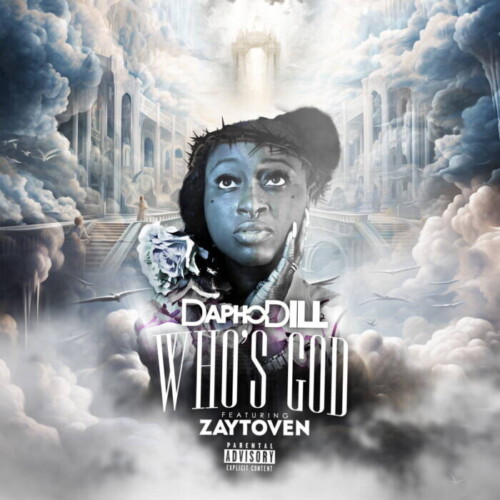
DaphoDILL featuring Zaytoven “Who’s God” single, brings breathtaking lyricism, as it captures, scripture and power, in one song. DaphoDILL being told about “Cheat Codes”, as a child, not knowing, what was in store for her life, as many damaged her as a child, and told her, that she would never be “God”, as those around her, silenced her, retaliated on her, for speaking out, and many adults and their children, abusing power, that was given to them, to protect themselves, as she was never able to protect herself at all. DaphoDILL’s lyricism, takes on a new vision of, if human-kind is “God”, and scripture is used to define power, and those scriptures, were written to silence, then “Who’s God”?
DaphoDILL’s lines, “Silenced in the contempt of a mortuary sin” is not metaphor for Black people in Mississippi — it is memory. Silence was enforced early: through fear, through underfunded schools, through a justice system that taught survival instead of truth. Growing up Black meant learning that speaking could cost your life, your freedom, or your sanity. The song opens in that suffocating space where souls are “dying within,” not buried by time, but “buried by men.”
As her education was never absent by accident — it was stolen on purpose. Mississippi, as other southern states, like Alabama, Louisiana, and Georgia, perfected the theft of knowledge, while pretending to offer it. Segregated schools became distorted classrooms; textbooks erased history; curiosity was treated like rebellion. “Grasp the color of law in a world so thin” captures how legality itself was racialized — truth bent to protect power while Black children were taught fragments instead of facts.
“Gun powder screams louder” because violence has always spoken clearer than policy. Lynching was never random; it was communication — a public warning, a terror ritual, a declaration of dominion. When the song asks “Higher power, whose Messiah,” the question isn’t religious — it’s historical. Who was crucified? Who was protected? And who decided that mercy didn’t apply to Black bodies hanging from trees?
The track cuts straight through religious hypocrisy: “They preach about Eve but they protect no daughters.” Mississippi wrapped misogyny in scripture while women were assaulted, dismissed, and blamed. Holy hands didn’t heal — they “turned holy hands into courtrooms,” where reputations mattered more than bodies. Enslavement never ended; it evolved into silence, shame, and forced forgiveness.
“Why the fuck is God on trial” flips the narrative back where it belongs. It isn’t Black people who need judgment — it’s the systems that claim God while committing harm. “Told me God don’t live in my skin” names anti-Black theology for what it is: a doctrine of exclusion designed to justify domination, punishment, and erasure.
Mississippi taught defiance was violence. “Burn off your desire while they strip you of your grace, then call you defiant.” Speak up and you’re aggressive. Resist and you’re criminal. Survive and you’re suspect. The song exposes how voices are beaten down, then blamed for bleeding — “beating down your voice fast then say that you’re violent.”
“Raised a flag for oppression, taught lynching as a message.” That line alone is a history lesson America still refuses to teach honestly. Hatred toward Black lives was normalized while obsession with Black bodies never stopped. The pen replaced the whip — “played God with a pen,” legislating morality, criminalizing identity, declaring “being gay is wrong within.”
Faith became weaponized. “Wrote commandments in big ink then victimized the struggle.” Laws claimed righteousness while targeting the vulnerable. Pain was penalized, truth was criminalized, and prisons became pulpits preaching superiority. Therapy offered no healing — “just medication and more silencing to flaw out the real story.”
“This is America where dreams die.” Depression is induced, despair is profitable, and survival is pathologized. When “suicide becomes homicide for the money,” the system no longer pretends neutrality. Black suffering is monetized while accountability disappears behind policy, profit, and plausible deniability.
Who’s God does not ask for permission — it demands reckoning. Backed by world-renowned producer Zaytoven, the track transforms Mississippi’s buried truths into testimony. The repeated question — “Who’s God” — is not blasphemy. It is exposure. Because when institutions play divine while denying dignity, the only faithful act left is to speak.
© 2025, MysticsEnt. All rights reserved.