
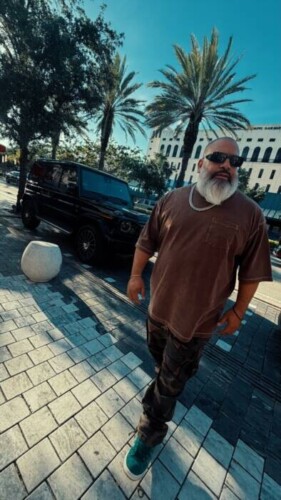
D’shon El Villano has never been the type of artist to comfortably fit into anyone else’s scene — and that may be exactly why his legacy in Miami and International hip-hop continues to grow. For over 20 years, the Villano Muzik Internacional founder has existed both inside and
outside of Miami’s underground rap world, respected by many while simultaneously clashing with parts of the city’s so-called “boom bap”
purist circles.
In a city known for cultural division, cliques, and gatekeeping, D’shon often represented something different. While certain underground rap
scenes in Miami stayed attached to traditional East Coast-inspired boom bap aesthetics and niche local politics, D’shon El Villano was
building a broader identity rooted in Spanglish lyricism, Caribbean influence, Latin street culture, reggaeton, dancehall, afrobeat, and raw
Miami reality. To some underground purists, that made him difficult to categorize. To others, it made him dangerous competition.
Over the years, tensions reportedly grew between D’shon and several figures within Miami’s underground circles, particularly among artists
who underestimated his versatility or dismissed his multicultural sound as being outside of “real hip-hop.” But instead of retreating, D’shon
responded the way battle-tested emcees traditionally do — through music, bars, and direct confrontation.
One of the most talked-about moments in local underground circles involved D’shon verbally dismantling one of Kendall’s more respected
mid-tier rappers during a lyrical back-and-forth that exposed the gap between image and substance. While names and narratives continue to
circulate through Miami’s hip-hop grapevine, many who followed the situation viewed it as a turning point: proof that D’shon El Villano was
far more lyrically dangerous than critics wanted to admit. His ability to switch between English and Spanish, mix street realism with layered
wordplay, and attack from multiple stylistic angles made him a difficult opponent in any format.
But what truly defines D’shon’s story is not conflict — it’s survival. Despite being overlooked, blackballed in certain spaces, and denied
opportunities that often went to more politically connected artists, he continued building independently. While others faded, D’shon stayed
active. He released projects, developed media platforms, expanded Villano Muzik Internacional, collaborated with respected producers,
and maintained a long-running independent relationship with EMPIRE. In doing so, he quietly became one of the few Miami
underground artists from the early 2000s era to sustain real longevity without abandoning his identity.
That perseverance eventually became part of his artistic power. The rejection, the tension, the resistance from parts of the local scene — all
of it sharpened his music. His records carry the energy of someone who had to earn every inch of respect without industry favoritism or
easy acceptance. That authenticity resonates in a way manufactured personas rarely can.
Today, D’shon El Villano stands as one of Miami’s most distinctive Spanglish MCs — an artist whose catalog reflects the true
multicultural reality of the city more accurately than many of his peers. His music refuses to be boxed into one genre, one language, or
one audience. And while some may have once viewed him as an outsider to certain underground circles, his consistency, lyrical ability,
and independent success have ultimately forced recognition. In many ways, D’shon El Villano’s career represents a different version
of Miami hip-hop history: one built not through gatekeeper approval, but through persistence, reinvention, and refusing to fold under
pressure.
https://www.dshonelvillano.com
https://empire.ffm.to/sonandovillano
https://www.instagram.com/villanomuzik
https://www.youtube.com/villanomuzikvevo
https://www.tiktok.com/@villanomuzik
© 2026, Tedfuel. All rights reserved.